 Vitlog

A calmer evening is often pictured as an empty calendar, a perfectly quiet bedroom, and plenty of time to unwind. Many people live with a different reality: work that finishes late, shared rooms, caring responsibilities, outside noise, or a schedule that changes from week to week. A useful routine starts by recognizing those circumstances rather than pretending they are minor details.
This guide combines a small amount of general sleep-health background with practical organization ideas. It explains how to review your evenings, choose a manageable change, keep simple notes, and prepare a clear conversation with a professional if sleep is a concern. It is not a treatment for insomnia, sleep apnea, or another condition.
Vitlog can store the sleep hours you choose to enter and a personal note. It does not measure sleep stages, calculate clinical sleep quality, or decide why you feel tired. If you have persistent problems, symptoms that concern you, or difficulty staying awake safely, seek appropriate professional advice. A diary can support a conversation, but it should not postpone one.
1. Begin with your actual schedule
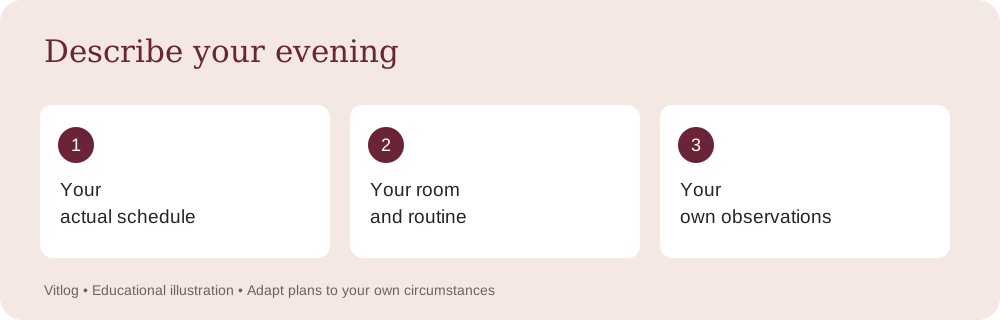
Write down when your responsibilities usually finish and when they begin again. Include commuting, meals, caring tasks, and preparation for the next day. This describes the time available for sleep more accurately than selecting an ideal bedtime without considering the rest of the evening.
You may discover that the main constraint is a work schedule or a household responsibility. Naming that constraint helps you identify which changes are within your control and which require a conversation with someone else. It also prevents a practical problem from being described only as a failure to follow a routine.
Choose an ordinary week to review, rather than a holiday or an unusually quiet period. A plan built around typical circumstances is easier to evaluate. If no week is typical, note the main types of schedule you work with and consider them separately instead of forcing them into one pattern.
2. Understand what general sleep advice can and cannot do
The CDC describes sleep habits such as keeping a regular schedule, creating a quiet and comfortable bedroom, and reviewing evening caffeine and screen use. The NHLBI also discusses consistent timing and a quieter period before bed. These are general suggestions, not a guarantee that a particular routine will resolve a sleep problem. [1][2]
You do not need to adopt every suggestion at once. Start by identifying which part of your current arrangements you want to understand. The answer could involve the environment, the schedule, an evening task, or a health concern that needs individual assessment.
Keep medical advice separate from personal experimentation. If a clinician has given you a treatment plan, use that guidance instead of substituting an online bedtime checklist. If you are considering a sleep aid or supplement, discuss it with an appropriate professional rather than treating an advertised product as a routine household purchase.
3. Choose one evening transition to simplify
An evening often contains a series of unfinished tasks. Cooking, messages, laundry, paperwork, and preparing for work can compete for the same period. Choose one transition where a small organizational change might make the evening less rushed.
For example, you might prepare tomorrow’s bag earlier, decide dinner before returning home, or agree when a shared task will be done. These changes do not require a medical claim about sleep. They simply make the sequence of the evening easier to describe and manage.
Avoid turning the new routine into another long list of obligations. A complicated wind-down checklist can become a demanding task of its own. Choose something you can explain in a sentence and review after trying it. If it adds more pressure than it removes, revise it rather than insisting that the plan must work unchanged.
4. Review the bedroom in practical terms
Look at the room as it is used, not as it appears in a photograph. Consider light, noise, temperature, bedding, shared access, and equipment that needs to remain nearby. Some conditions can be adjusted easily; others may depend on housing, finances, work, or another person’s needs.
Make a short list of realistic options. You might change where a lamp is placed, arrange essential items before bedtime, or discuss a recurring source of noise. Check that any adjustment is safe and compatible with your circumstances, especially if you need monitoring equipment, mobility support, or access to a child or dependent.
There is no need to buy a large collection of bedroom products before reviewing the basics. An expensive accessory does not replace medical assessment when symptoms are present. Focus first on describing the actual problem clearly, then consider what kind of support or change could address it.
5. Make a deliberate plan for devices and messages
Devices can serve several purposes at night: communication, alarms, entertainment, work, and access to important information. Instead of assuming they can simply disappear, decide which functions you need and which activities you would prefer to move earlier.
A practical change could involve charging a device in a chosen place, adjusting nonessential notifications, or writing down tomorrow’s task before closing a work application. If you must remain reachable, consider how to preserve that access without treating every message as equally urgent.
Keep the plan flexible enough for your responsibilities. Someone on call or caring for another person may need a different arrangement from someone with an uninterrupted evening. The question is not whether your bedroom follows a particular aesthetic. It is whether the arrangement fits your circumstances and whether any persistent sleep concern needs professional attention.
6. Notice the timing of drinks and meals
If you want to discuss your evening routine, it can be useful to know when you usually eat or drink. A brief note about an unusually late meal or an afternoon caffeinated drink may provide context without turning the diary into a detailed food log.
General sleep guidance includes reviewing caffeine and alcohol near bedtime. [1][2] Individual medical needs can affect what changes are appropriate, so follow your existing guidance and ask questions if you are uncertain. Do not use a sleep article as a reason to skip a meal required by your care plan.
Choose a record that is easy to maintain. You might write “usual routine,” “later dinner,” or another description that has a clear meaning to you. If a clinician asks for more precise information, agree on what to record. Collecting more detail than anyone needs can make the process harder to sustain.
7. Decide what your sleep entry means
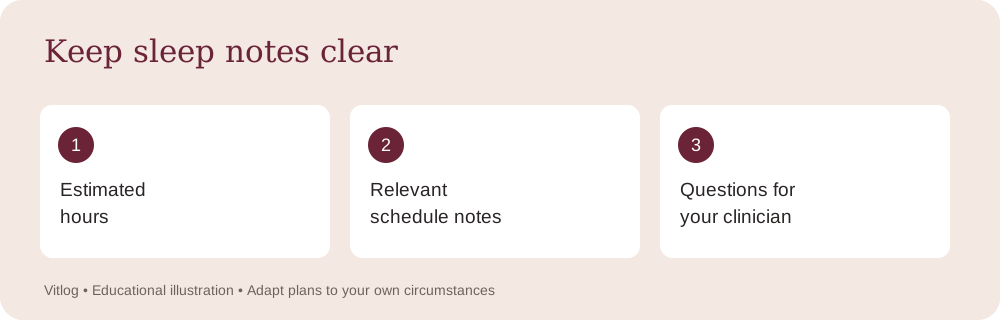
Before entering a number, decide whether you are recording estimated time asleep or simply the interval between going to bed and getting up. Those are different descriptions. A record becomes difficult to review if the meaning changes silently from one day to another.
Vitlog’s sleep field is a manual entry in hours. It does not measure sleep automatically. If your number is an estimate, you can say so in the notes. If you only know the time spent in bed, explain that rather than presenting it as a precise measurement of sleep.
You do not need to watch the clock continuously to create a useful entry. Excessive checking may make the record more burdensome. Use the level of detail agreed with your clinician when a diary is part of care, and otherwise keep your notes proportionate to the question you are exploring.
8. Add context without creating a daily performance score
A sleep note might mention a late shift, a noisy night, an early appointment, or an interrupted evening. That information can make the entry easier to understand later. It does not need to label the night as a success or failure.
Separate the event from your explanation for it. “The room was noisy” describes a circumstance. “This is definitely why I slept differently” makes a conclusion that the diary cannot establish on its own. You can note a possible connection while remaining open about uncertainty.
Avoid comparing your record with screenshots from other people’s devices. Their measurements, schedules, and circumstances may differ. A personal journal is most useful when it preserves your own information consistently. It is not a competition to produce the longest duration or the smoothest chart.
9. Use a logging reminder at a convenient time
A reminder should help you record information when it is easy to do so. For sleep notes, some people may prefer reviewing the previous night during the day rather than opening an app immediately before bed. Choose the arrangement that fits your own schedule.
Vitlog offers optional in-app reminders and email or SMS channels when the site’s delivery services are configured. The reminder is a general prompt and contains no health readings. It is not an instruction about when to sleep, and it does not mean that anyone is watching your night’s progress.
If a reminder becomes distracting, change its time or turn it off. Check the selected time zone after travel or a move. Your reminder preferences should serve your record-keeping routine, not become another source of pressure at the end of the day.
10. Look for practical patterns before making conclusions
When reviewing entries, begin with questions you can answer from the record. Did the logging method stay consistent? Were several nights affected by a changed work schedule? Are there gaps that need an explanatory note? Are you comparing estimated sleep with time in bed by mistake?
A short period may reveal organizational problems, but it does not prove the cause of a sleep difficulty. A diary can leave out important health information and may contain uncertain estimates. Keep those limitations visible when discussing a pattern.
Choose one observation to bring forward. You might decide to record shift changes more clearly or to simplify the way you enter hours. If the pattern concerns symptoms or persistent daytime difficulty, bring it to a clinician. Do not assume that a more elaborate chart will replace the need for an assessment.
11. Plan for shared homes and caring responsibilities
Not everyone controls the bedroom environment or the timing of the household. Shared rooms, children, dependent adults, neighbors, and a partner’s schedule can all shape the evening. A realistic routine needs to account for those relationships rather than treating sleep as an entirely individual project.
Where possible, discuss a specific recurring issue and a practical arrangement. A conversation about when a noisy task is done may be clearer than a general request for everyone to be quieter. The solution might involve shared planning, not a new product or a stricter personal checklist.
Keep another person’s privacy in mind when writing notes. You can describe that you had a caring interruption without recording their diagnosis, personal information, or identifying details. Your journal may later be exported, and it should not become an unintended record about someone else.
12. Handle shifts, travel, and unusual weeks honestly
A conventional evening routine may not fit shift work or frequent travel. Record the schedule you actually follow and ask for appropriate individual guidance if sleep is difficult. A general article cannot decide the safest arrangement for every occupation or medical situation.
When traveling, note time-zone changes if they matter to your record. Check whether the journal’s entry date describes the period you intended. If a night spans two calendar dates, choose a consistent convention and explain it if you share the record with a professional.
Do not fill an unfamiliar week with guessed values to maintain a continuous history. A gap with an honest note is more useful than false precision. Once the schedule settles, review what is practical now instead of assuming you need to compensate for the disruption with a rigid new routine.
13. Know when a diary is not enough
Persistent trouble sleeping, regular difficulty staying awake during the day, or other concerning symptoms deserve professional attention. A journal may help you describe what is happening, but it should not be used to postpone a conversation while you wait for a more complete record.
If someone reports unusual breathing during sleep or you have another specific concern, tell your clinician what was observed. You do not need to diagnose the cause yourself. The appropriate assessment depends on information that an educational website cannot collect or evaluate.
Safety takes priority over logging. If you feel unable to drive or perform another task safely because of sleepiness, do not rely on a diary score as reassurance. Seek appropriate assistance and follow relevant medical or workplace instructions. A number entered in an app is not a fitness-for-duty assessment.
14. Prepare a clear conversation with a professional
Before an appointment, write down the main concern in plain language. Note when it began, how it affects your day, and what you would like help understanding. Bring a short, relevant period of entries if available, and explain how the hours were estimated.
You could ask what information would be useful to record next, whether a symptom needs assessment, or whether your schedule requires different advice. If you use a device that reports sleep metrics, identify the device and distinguish those estimates from your own notes.
Share records through a channel appropriate to the clinician or service. A reminder email is not a clinical communication system. You can export your entries, but review the notes for private information before sending them. Clear questions and an honest description of uncertainty are more valuable than a perfectly formatted report.
A manageable review for the coming week
Choose one practical part of your evening to observe, such as preparation for tomorrow or the timing of a recurring household task. Record the information in a simple way without changing several habits at once. At the end of the week, ask whether the record answered your original question.
If it did not, simplify or clarify the next step. Perhaps the entry needs a brief schedule note rather than another number. Perhaps the concern is already clear enough to discuss with a professional. The aim is to understand your circumstances and obtain suitable support, not to create a flawless bedtime routine.
Frequently asked questions
Can Vitlog tell whether I have a sleep disorder?
No. It stores the hours and notes you enter. It does not diagnose insomnia, sleep apnea, or other conditions, measure sleep stages, or prescribe treatment. Discuss persistent difficulties or concerning symptoms with a qualified professional.
Should I enter a precise number if I am unsure?
Use an honest estimate and identify it as an estimate in your notes when useful. Do not invent precision. If a clinician has asked you to keep a particular type of sleep diary, follow those instructions.
Do I need to change every evening habit together?
No. For general organization, one clearly described change is often easier to review than several simultaneous changes. Medical treatment plans may involve different instructions, so follow the advice provided specifically for you.
Does an email reminder contain my sleep information?
No. Daily entry reminders are general prompts and do not include your readings or personal notes. You can disable the email channel independently in the reminder settings.
Sources and editorial note
[1] CDC, About Sleep: https://www.cdc.gov/sleep/about/index.html
[2] NHLBI, Healthy Sleep Habits: https://www.nhlbi.nih.gov/health/sleep-deprivation/healthy-sleep-habits
The schedule exercises, household examples, and record-keeping prompts are original editorial suggestions. Source links support general sleep-habit background and do not endorse Vitlog. This article provides educational information, not a diagnosis, treatment plan, or promise of improved sleep.