 Vitlog

It is easy to imagine being more active during an unusually quiet week. The harder question is what movement can look like during the week you actually have: work, appointments, family responsibilities, travel, weather, and days when you have less energy. A useful routine begins with those conditions rather than assuming they will disappear.
This guide focuses on planning, choosing accessible options, recording what you do, and reviewing the practical barriers that arise. It is not an exercise prescription, a rehabilitation program, or a promise of weight loss. If you have a medical condition, symptoms, an injury, or uncertainty about suitable activity, ask a qualified professional what is appropriate for you. Follow any instructions already provided by your care team.
Your personal journal can support the organization of a routine. It can store activity minutes, dates, and notes about the circumstances. It cannot assess whether an activity is safe for you or decide how much you should do. Keeping that distinction clear makes the journal a more useful companion to informed decisions.
1. Understand the difference between public guidance and a personal plan
The CDC describes general adult recommendations that include at least 150 minutes of moderate-intensity aerobic activity per week and muscle-strengthening activity on two days. It also explains that activity can be divided across the week and that some activity is better than none. Individual circumstances can require adaptations. [1]
Those public recommendations provide context, not a test you must pass before recording anything. A person returning after an injury, someone managing a chronic condition, and someone already active may need very different plans. Ask how the guidance applies to your own abilities and circumstances before using a number as a target.
For planning purposes, write down what you currently do before adding a new goal. This might include a familiar walk, an activity class, or another routine. An accurate starting description is more useful than choosing a demanding target because it sounds impressive. Your first journal entry can simply describe where you are now.
2. Notice the shape of your ordinary day
Look at the actual points where your schedule changes: after waking, arriving at work, lunch, the end of a shift, returning home, or finishing household tasks. These transitions can help you identify when an activity might fit. The goal is to find a realistic opening, not to fill every spare minute.
Write down what usually happens during one possible opening. You may discover that your lunch break is shorter than you thought, that an evening commitment often runs late, or that a route is inconvenient in certain weather. Those details belong in the plan rather than being treated as excuses after the fact.
Choose one opening to investigate first. If it does not work, you will have learned something specific about the schedule. Trying to create several new routines at the same time can make it harder to identify which practical change would actually improve the situation.
3. Choose an activity you can describe clearly
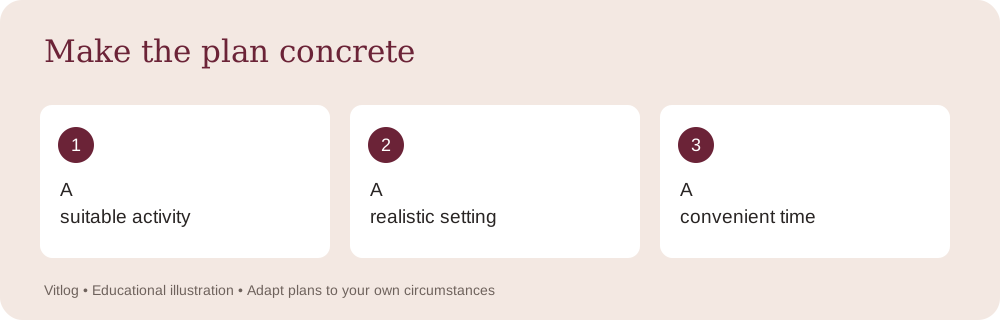
“Be more active” is difficult to prepare for. A clearer description names an activity, a setting, and the conditions you need. For example, you might consider a familiar walking route, a suitable seated class, or an activity recommended by your physiotherapist. The appropriate choice depends on your own circumstances.
Describe what participation involves. Is there transport to arrange? Do you need an accessible entrance, a changing area, an instructor, or a specific time slot? If someone else is involved, find out whether their schedule matches yours. These questions turn a vague intention into a decision that can be checked.
Enjoyment also belongs in the description. You may prefer an activity alone, with a friend, outdoors, or in a quieter indoor setting. There is no requirement to adopt the most visible activity in your social group. A routine should account for your preferences as well as its practical requirements.
4. Make the environment part of the plan
Consider the place where the activity would happen. A walking route may have uneven surfaces, limited lighting, traffic crossings, or few places to rest. An indoor space may have access rules or equipment that requires instruction. Check the conditions before relying on the location as a regular option.
Weather and seasonal changes can affect convenience. Instead of assuming the same arrangement works all year, write down an alternative for a day when the original setting is unsuitable. The alternative should be something you have already considered for your abilities, rather than an improvised challenge.
Keep the first version simple. You may not need new equipment or a membership to explore an appropriate option. Equally, some activities do require specific equipment or supervision. Ask a qualified instructor or clinician when you are unsure. A planning article cannot determine whether a particular environment meets your needs.
5. Reduce the preparation decisions
A routine can become difficult before the activity begins. Missing shoes, an uncertain route, a forgotten booking, or an uncharged device may each create another decision. Identify which preparation tasks are predictable and complete them at a convenient time.
For example, you could place suitable clothing where you will find it, confirm the class location, or write the route in your calendar. These are organization steps, not medical interventions. They can help you discover whether the main obstacle is preparation rather than the activity itself.
Avoid buying a large collection of equipment before you know what the routine involves. Start by checking what is actually necessary and what you already have. If you need specialist footwear, mobility support, or another adaptation, seek individual guidance. Preparation should match the activity and the person instead of following a generic shopping list.
6. Use smaller decisions when the day changes
A plan should leave room for a day that turns out differently. You may be delayed at work, need to care for someone, or discover that a venue is unavailable. Decide in advance how you will respond so that the choice is not automatically between completing the original plan and doing something unsuitable.
One option is to move the activity to another appropriate time. Another is to use a familiar alternative. Sometimes the right choice is to postpone it and seek advice, especially if illness, pain, or new symptoms are involved. Flexibility does not mean ignoring information about your health.
Record the change briefly if that is useful. “Class canceled” or “schedule changed” explains a gap more clearly than a harsh judgment about motivation. Over time, these practical notes can help you choose arrangements that are less dependent on conditions outside your control.
7. Separate movement planning from a weight-loss deadline
It can be tempting to attach a fixed weight change to a new activity routine. That creates an expectation this article and your journal cannot justify. Body weight is influenced by many factors, and a personal activity record does not establish how much weight you will lose or when.
Instead, describe an organizational aim you can actually observe. You might want to find a convenient activity, attend a suitable class, or record your activity consistently enough to discuss it with your clinician. These aims do not require a predicted result on the scale.
If weight management is part of your care, ask your clinician how activity fits into your overall plan. Keep any prescribed guidance separate from assumptions made from a graph. Vitlog can store a self-chosen goal, but it does not calculate a medically appropriate weight target or recommend a calorie expenditure requirement.
8. Record what happened, not what you hoped happened
An activity journal works best when it describes the day you experienced. Enter the date, the activity minutes you choose to track, and a short note if needed. Do not fill a missed entry with a number simply because it matches your original plan.
There may be times when the duration is approximate. If so, say that in the notes rather than presenting the estimate as a precise measurement. A simple, honest record is easier to review than a polished series of numbers whose meaning has changed from one day to another.
You can also record the setting or the reason for a change. “Walked with a friend,” “used indoor alternative,” or “appointment ran late” may be enough. Avoid putting identifying information about other people into your record. The purpose is to preserve context about your own routine.
9. Choose a reminder that supports the record
A reminder can prompt you to log an activity after it happens. It should not imply that you must exercise when a message arrives or that the website is checking your health. In Vitlog, choose a logging time that is convenient for reviewing your day.
Select the channel you prefer: an in-app reminder, an optional email reminder, or an SMS reminder where delivery has been configured and you have opted in. Keep the reminder general so that personal readings are not exposed on a phone lock screen or in an email subject.
If reminders become distracting, adjust or disable them. A notification that repeatedly arrives at the wrong time is a scheduling problem to solve, not an instruction to ignore your circumstances. Your journal should remain a tool you control. No reminder can replace professional advice about whether to participate in an activity.
10. Review a week without creating a daily score
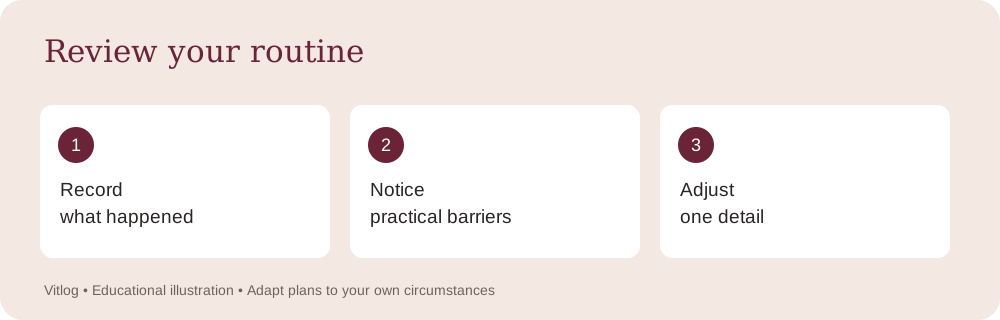
When reviewing your entries, begin with concrete questions. Which time slots were available? Which activities required more preparation than expected? Was transport the main difficulty? Did a particular arrangement fit your working day better than another?
A week with gaps may still answer those questions. You do not need to convert every entry into a success or failure label. If several planned sessions were affected by the same practical problem, changing the arrangement may be more useful than repeating the same plan with stronger language.
Choose one observation to carry into the following week. For example, you might keep the location but change the time, or confirm a booking earlier. If the record includes pain, unusual fatigue, or other health concerns, discuss them with a qualified professional rather than using the review to set a more demanding target.
11. Include accessibility and support needs from the beginning
Accessible planning starts with the person, not with a standard activity that must somehow be made to fit. Consider transport, surfaces, rest opportunities, sensory conditions, facilities, and the availability of appropriate instruction. Ask the venue or instructor specific questions before making a commitment.
If you use mobility equipment or have a condition that affects activity, follow advice from your own care team. A friend’s experience or an online demonstration may not address your situation. Seeking an adapted option is a practical part of planning, not an inferior version of someone else’s routine.
Support can also mean having another person help with scheduling, transport, or remembering what to ask. Decide what information you are comfortable sharing. A full health-history export is not necessary for every conversation about joining a class. Share only the details relevant to the person and the task.
12. Plan for work, travel, and unfamiliar weeks
A routine built around home may not transfer directly to a trip or an unusual working week. Before traveling, check which arrangements will still be available. Consider time zones, local conditions, transport, and whether your usual reminders will arrive at a useful time.
A short trip does not require recreating your entire routine in an unfamiliar place. Choose appropriate options you can verify, or decide to keep a simpler record during the change. Your journal can include a note explaining that the week had different conditions.
After returning, resume by reviewing what is practical now. You do not need to “make up” every missed activity with a sudden increase. If your circumstances or health have changed, ask for individual guidance. The record should make the transition easier to describe rather than creating pressure to compensate for a calendar gap.
13. Prepare useful questions for an appointment
If you discuss activity with a clinician or physiotherapist, bring questions tied to your actual routine. You could ask whether the chosen activity suits a condition, whether a symptom needs assessment, or whether an adaptation is appropriate. A specific example often makes the conversation clearer.
Your notes might show when an issue occurred, what you were doing, and what made you stop. Do not wait for the next routine appointment if the concern is urgent. Follow your existing care instructions and seek appropriate medical assistance when needed.
An export from Vitlog can organize entries for discussion, but it does not establish a diagnosis or prove the cause of a symptom. Tell the clinician how the information was recorded, including whether durations were estimated. Clear context is more useful than presenting an app-generated graph as a medical assessment.
A practical first-week planning exercise
Begin by describing one suitable activity you already know or have discussed with a professional. List the place, the preparation required, and a possible time. Identify one predictable obstacle and write a reasonable alternative. Keep the exercise focused on arrangements rather than choosing a dramatic performance target.
After the activity, record what actually happened. At the end of the week, review the notes and change one practical detail if needed. You may discover that the first arrangement works well, or that it needs a different setting or time. Either result gives you specific information for the next decision.
Check the practical cost of the arrangement
A routine may involve costs beyond the activity itself. Consider transport, booking charges, childcare, equipment, and the time needed to get ready. Write those requirements down before assuming a recurring arrangement is affordable. If a cost becomes difficult, investigate suitable alternatives instead of committing to a payment you cannot maintain. An alternative may be a different venue, a community program, or another activity you have already considered with appropriate guidance. Keep the decision specific to your circumstances. Paying more does not make a routine automatically more suitable, and using a simple option does not make your record less worthwhile.
Frequently asked questions
Do I need to complete a full workout before recording anything?
No. A personal record can describe the activity you actually did. Public recommendations and personal exercise prescriptions are different things. If you need advice about an appropriate amount or type of activity, ask a qualified professional who knows your circumstances.
Does Vitlog measure calories burned?
No. The activity field stores the minutes you enter and your optional notes. It does not calculate an individualized energy expenditure, recommend a calorie deficit, or connect activity entries to a promised weight change.
Should I follow a reminder if I feel unwell?
A logging reminder is not an instruction to exercise. Follow your care plan, consider your symptoms, and obtain medical advice when appropriate. The website does not monitor your condition or decide whether activity is safe on a particular day.
What should I do after several missed entries?
Resume with the information you have. You can leave a gap or add an accurate note about the period. Do not invent activity minutes to create a continuous chart. Review whether the logging time or the planned activity needs adjustment.
Sources and editorial note
[1] CDC, Adult Activity: An Overview: https://www.cdc.gov/physical-activity-basics/guidelines/adults.html
[2] CDC, Adding Physical Activity as an Adult: https://www.cdc.gov/physical-activity-basics/adding-adults/index.html
The scheduling exercises, journal prompts, and illustrative planning examples are original editorial suggestions. Source links provide general public-health context and do not endorse Vitlog. This article is educational information, not an individual exercise prescription or medical advice.